Vaupel Engraved Glass in American Museums
By Carl U. Fauster
Reprinted from The Hobstar, January 1990
 Louis F. Vaupel
(1824 - 1903) was a skilled glass engraver when he immigrated to America in 1850. He
found work at the New England Glass Works at Cambridge, Massachusetts, where he became the
designer and head of the engravers until Edward Drunimond Libbey moved the factory to
Toledo, Ohio, in 1888 and changed its name to Libbey Glass Company. Vaupel did not move
with the other workers because of his wife's very poor health and the fact that he
owned residential property in Cambridge. He remained there, continuing to do commissioned
engraving with the wheels in his home until he died in 1903. Louis Vaupel's work was
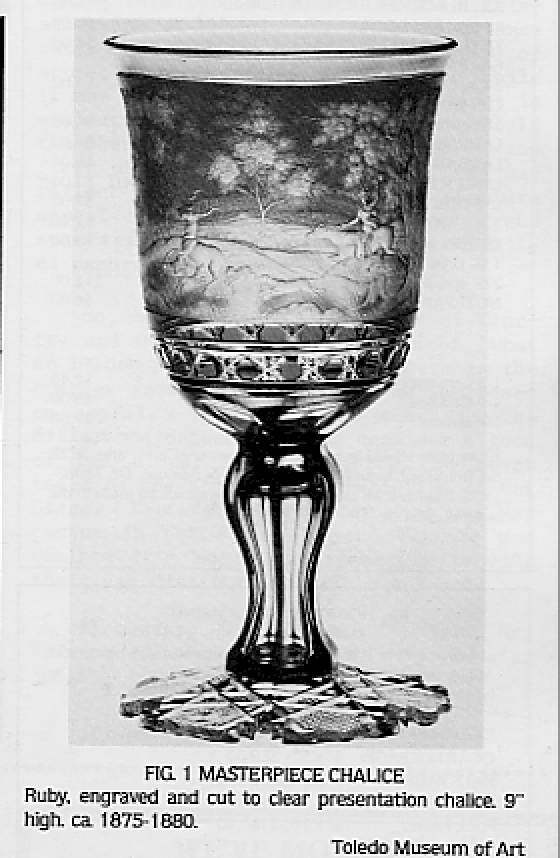
considered to be of museum quality by experts, with his Masterpiece Chalice labeled as the
high point in American Middle Period engraved glass.
Louis F. Vaupel
(1824 - 1903) was a skilled glass engraver when he immigrated to America in 1850. He
found work at the New England Glass Works at Cambridge, Massachusetts, where he became the
designer and head of the engravers until Edward Drunimond Libbey moved the factory to
Toledo, Ohio, in 1888 and changed its name to Libbey Glass Company. Vaupel did not move
with the other workers because of his wife's very poor health and the fact that he
owned residential property in Cambridge. He remained there, continuing to do commissioned
engraving with the wheels in his home until he died in 1903. Louis Vaupel's work was
considered to be of museum quality by experts, with his Masterpiece Chalice labeled as the
high point in American Middle Period engraved glass.
When the Libbey Glass Co. approached its 150th Anniversary in 1968, it was my good
fortune as Advertising Manager to be involved in plans to commemorate this milestone in
the firm's history. The outstanding event would be a major exhibition, "Libbey
Glass, a Tradition of 150 Years," at the Toledo Museum of Art, an institute founded
by Edward Drummond Libbey in 1901. Mr. John W. Keefe, then Assistant Curator at the
Museum, was to be responsible for research and organization of the exhibition, including
the writing of the catalog. In seeking to borrow rare and beautiful glass for the historic
exhibition, Mr. Keefe and I went to Boston to visit the descendants of glassworkers; families. It was during one of these trips that I first became acquainted with Louis F.
Vaupel’s grandson, John L. Vaupel (1899 - 1980).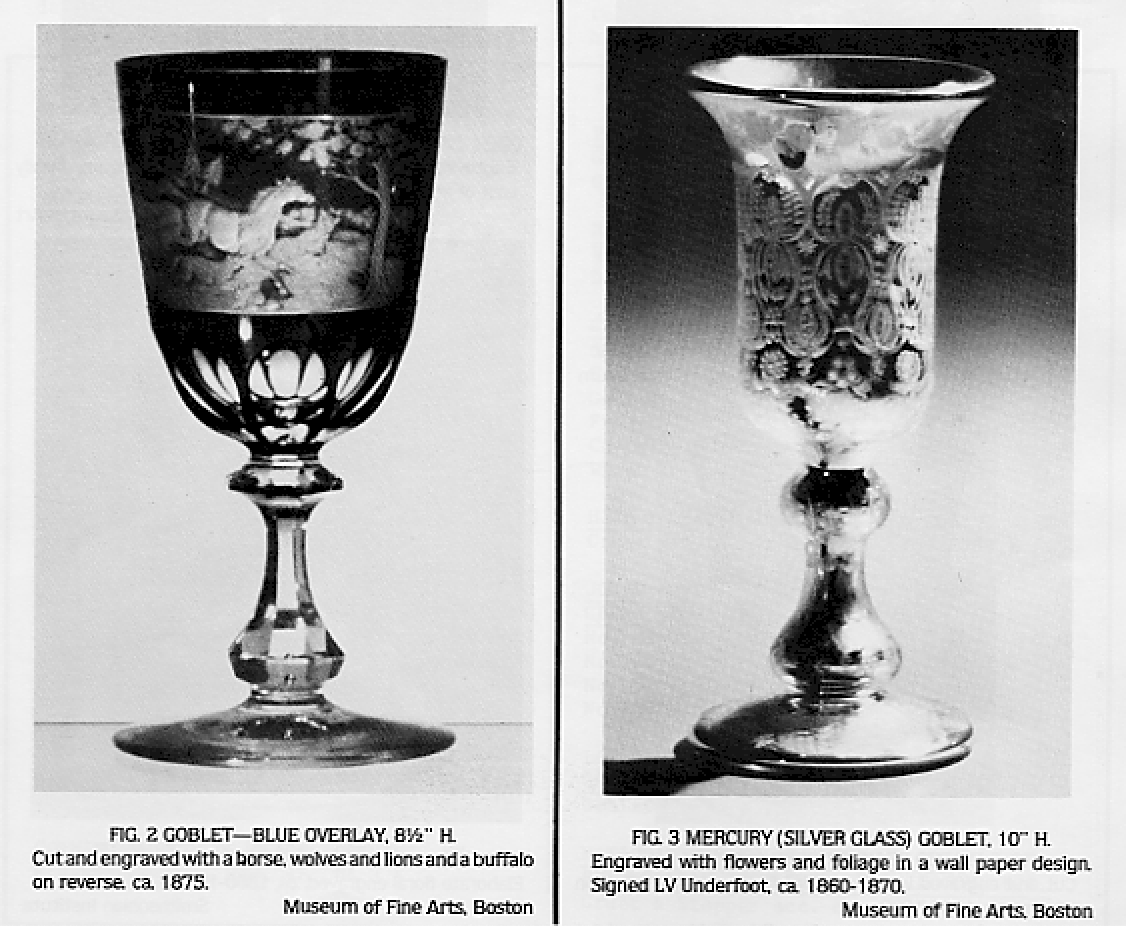
A retired civil engineer, the second American-born Vaupel was most cooperative, being well aware of the historic importance of the family collection of glass engraved by his grandfather. The collection was most impressive, the outstanding piece being the Masterpiece Chalice, which up to this point in time had never been out of the family's hands. Mr. Vaupel agreed to lend the Chalice for the exhibi-tion provided that I, personally, take the piece to Toledo and return it to Boston at the close of the exhibition, with the Museum insuring it for $15,000. With the Vaupel Chalice as one of its features, the Museum exhibition was a major success, well publicized both locally and nationally, running from March 17 to April 7, 1968.
 After my participating in the Libbey Anniversary events and visits in Boston, I decided
to compile an article which was eventually published in the May, 1971, issue of The
Magazine ANTIQUES, entitled, "Louis Vaupel, Master Glass Engraver." In preparing
the piece, the needed help from grandson John was generously given. Color illustrations
were supplied along with detailed information, requiring considerable correspondence that,
today, is of historic value. In 1972, Mr. Vaupel realized that the family's
collection of 19th Century glass should be preserved for its historic importance. When he
asked me if I could help in placing pieces in museums and private collections, we agreed
to an arrangement whereby we would share the costs of promoting the offering and I would
be given a commission on all sales for my services. Accordingly, a mailing was made to
American museums, with a detailed listing and a reprint in color of my article in The
Magazine ANTIQUES. The response was prompt and most encouraging.
After my participating in the Libbey Anniversary events and visits in Boston, I decided
to compile an article which was eventually published in the May, 1971, issue of The
Magazine ANTIQUES, entitled, "Louis Vaupel, Master Glass Engraver." In preparing
the piece, the needed help from grandson John was generously given. Color illustrations
were supplied along with detailed information, requiring considerable correspondence that,
today, is of historic value. In 1972, Mr. Vaupel realized that the family's
collection of 19th Century glass should be preserved for its historic importance. When he
asked me if I could help in placing pieces in museums and private collections, we agreed
to an arrangement whereby we would share the costs of promoting the offering and I would
be given a commission on all sales for my services. Accordingly, a mailing was made to
American museums, with a detailed listing and a reprint in color of my article in The
Magazine ANTIQUES. The response was prompt and most encouraging.
At the time of this offering, our research indicated that three museums already had examples of Vaupel engraved items in their collections: The Brooklyn Museum, The Museum of Fine Arts, Boston, Massachusetts, and the Currier Gallery of Art, Manchester, New Hampshire. These acquisitions had either been purchases or gifts, such as the pieces in the Boston Museum, which were bequeathed to the museum by Dr. Minette D. Newman, grand-daughter of Louis Vaupel.
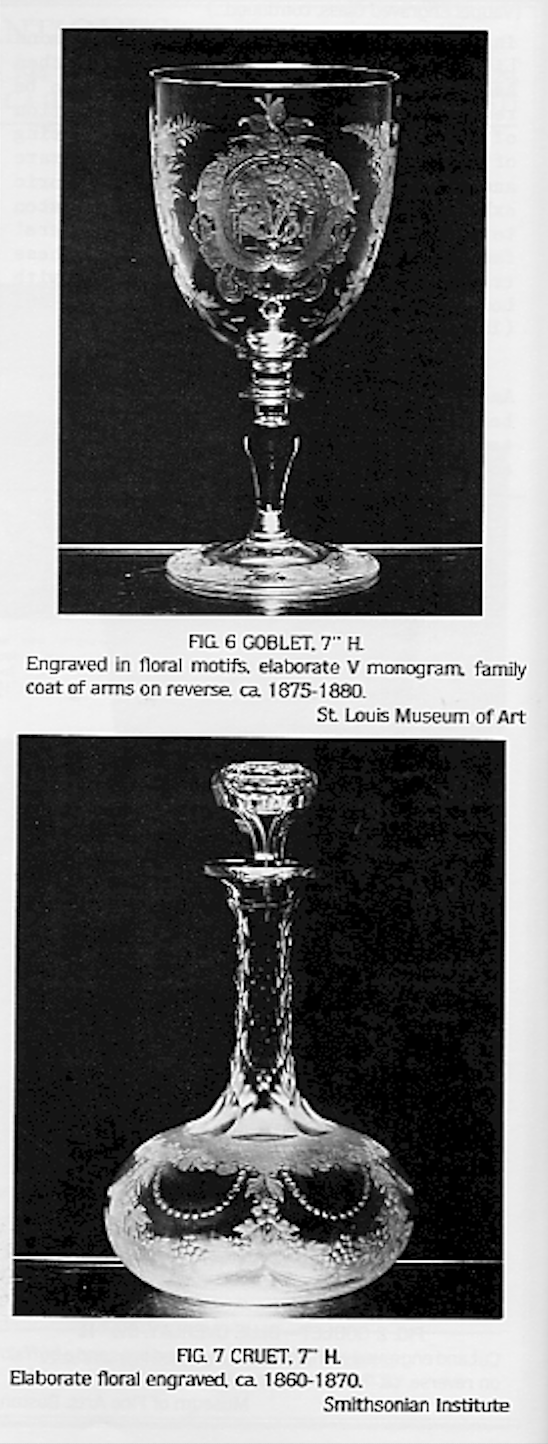
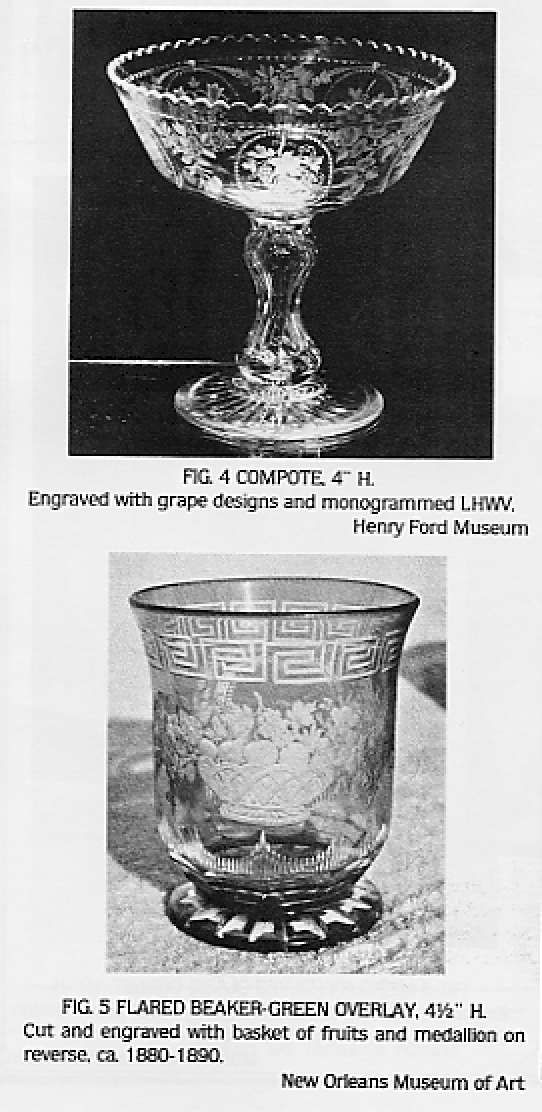
Using this earliest information as the starting point, our most recent project has been to update the survey of all Amer-ican museums having Vaupel—attributed items engraved by Louis Vaupel. Our questionnaire was mailed to some 30 museums, with returns from all of them, indicating the overall interest in our research. Eleven museums can now be added to the earlier three, making a total of 14 American Museums with Vaupel documented pieces.
When John Vaupel died July 20, 1980, at Boothbay, Maine, he had the satisfaction of knowing that through his thoughtful efforts, Louis Vaupel's work had been placed quite properly in a number of American museums. No other single American glass craftsman can match such recognition. Having assisted in obtaining this recognition has given me, as a glass historian, much personal satisfaction.
Survey of Museums Having Vaupel Engraved Items in their Collections - 1989 |
|
|---|---|
TOLEDO MUSEUM OF FINE ART, TOLEDO, OHIO
MUSEUM OF FINE ARTS, BOSTON, MASS
|
BROOKLYN MUSEUM, NEW YORK, NY: Wine acc. no. 45.143.ii Double Perfume " " 45. 143. 11 CURRIER
GALLERY OF ART, MANCHESTER, NH: HIGH MUSEUM OF ART, ATLANTA, GA: JONES MUSEUM OF GLASS & CERAMICS, EAST BALDWIN, MAINE: LOS ANGELES COUNTY MUSEUM OF ART, LOS ANGELES, CALIF: NATIONAL MUSEUM OF AMERICAN ART, SMITHSONIAN INSTITUTE, WASHINGTON
D.C.: |